By
Clare on
January 20, 2011
Public Speaking
Today I gave a presentation to 200ish staff at work. Am not generally a particularly outgoing person and you won’t often find me speaking in front of large groups. But I loved it. I loved being pushed. Being out of my comfort zone. Rising to the challenge. Doing something that I knew at least 80% of the audience would probably never do. The two main things that I think made a huge impact on how I performed and how I felt about it (both before, during and after) were 1) I was interested in, understood, and cared deeply about the content, and 2) practice, practice, practice. I had a similar feeling after delivering training as part of my train-the-trainer course (and the same reasons applied then too).
Wedding Song List
So far, the definites on my list are…
All Over Again – Sharon Jones & the Dap-Kings
Oops! – Louis Armstrong & Ella Fitzgerald
This Will Be (An Everlasting Love) – Natalie Cole
It’s Growing – Margie Joseph
By
Clare on
January 19, 2011
The slightly random things that I’ve noticed/have been pondering today…
The science of love, and the future of women – Helen Fisher
“Love” is fascinating… And this is such an interesting talk which makes me think lots about the relationships between neuroscience, emotions and behaviour.
Sorry
What does ‘sorry’ mean? How do different people use the expression ‘sorry’ differently? Can this lead to frustration/confusion? Can you use ‘sorry’ too much? Does it lose its meaning to the person saying it, and the person hearing it when it’s used frequently? Can it be used as an expression of sympathy, without apology for wrong doing or a mistake?
Definitions and uses for the word ‘sorry’ from the Macmillan Dictionary
The Holstee Manifesto

Love it!
Company manifesto from Holstee (kickass products, sustainably made, with a social impact).
via David Hood
Dahl
Jason and I made dahl for the the first time (recipe from Maeve O’Meara’s Food Safari). But we used canned lentils (from the back of the pantry and therefore of indeterminate age) and olive oil instead of ghee… And the result was okay, but not great… Next time I’m going to try Emily’s recipe – which I only remembered was included as an appendix to the 2010 Backhouse Lecture [pdf] after we’d starting making our batch.
By
Clare on
January 4, 2011
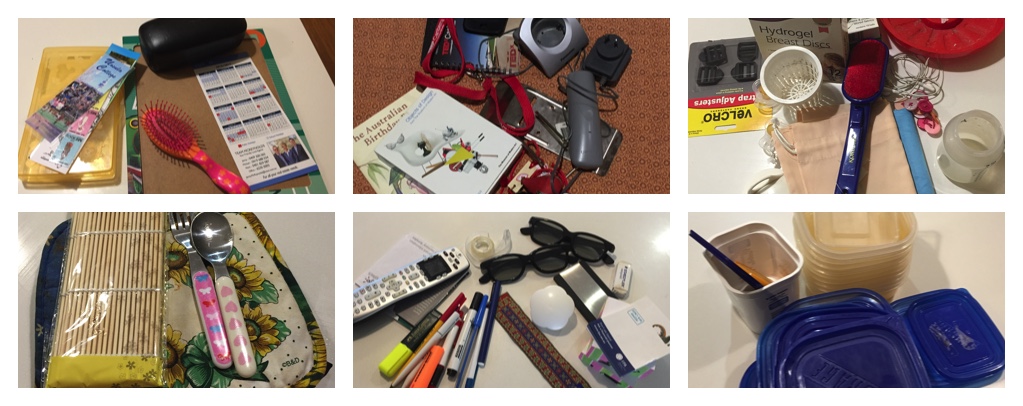
I’ve been doing a lot of thinking and reading about story-telling lately (see my recent book reviews) and want to find more ways to use and promote ‘story-telling’ in my work and my side-projects. I am a big believer in the utility and power of pictures to elicit stories (and memories, opinions etc) so I’ve made myself a set of picture cards and am quite pleased with the result.

Mostly the images are (creative commons licensed content) from Flickr (with a couple of my own photos included) which I had printed as 6×4 photos at Officeworks (for 10c per print). I recorded the Flickr attribution on the reverse of each photo and laminated them, and now have this great set of 33 cards (which I’ll keep adding to).
By
Clare on
January 1, 2011
Total Recall: How the E-Memory Revolution Will Change Everything by Gordon Bell
My rating: 4 of 5 stars
The coming world of Total Recall will be as dramatic a change in the coming generation as the digital age has been for the present generation. It will change the way we work and learn. It will unleash our creativity and improve our health. It will change our intimate relationships with loved ones, both living and dead. It will, I believe, change what it means to be human.
This book is based heavily on Gordon Bell’s experience with the MyLifeBits research project – a prototype system to digitally record, store, and organise as many aspects of Bell’s life as possible. This involved converting all paper based information (bills, receipts, certificates, photos, letters etc) to digital format and also digitally logging a range of life information on an ongoing basis (location, financial transactions, photos/video, health information, exercise details etc). The book distinguishes between the practices of life blogging (publicly broadcasting details of your life through sites like Facebook and Twitter) and life logging. (more…)
By
Clare on
December 28, 2010
Improving Your Storytelling by Doug Lipman
My rating: 3 of 5 stars
This book is aimed at the reader who has already had some experience with storytelling and is ready to learn more. Given the authors professional background, much of the book is focused on ‘performance storytelling’ so may not seem all that relevant to those that are interested in storytelling in other settings (particularly business/organisations). However, I particularly enjoyed the chapters on ‘What is a Story?’, ‘Learning the Story’ and ‘Discovering the Meaning’. The information in these chapters is valuable and applicable to all storytelling, regardless of the context/environment. Compared to ‘The Story Factor’, ‘Improving your Storytelling’ is a more practically focused book and offers more ‘how-to’ type information.
My notes from Improving your Storytelling: Beyond the Basics for All Who Tell Stories in Work and Play
[Disclaimer: The notes below are rough, and may be a mixture of direct quotes, paraphrasing, and my own thoughts/ideas/reminders. They're written here primarily for me (so they may not make much sense out of context, especially for those who haven't read the book)].
(11) Whether you think of yourself as a ‘storyteller’ or not, you tell people what happened to you.
(13) The best assistance doesn’t ‘fix’ your story or tell you what to do. The best help improves your ability to make your own decisions. It doesn’t paint the screen. (more…)