
My big baby turned 5 a couple of weeks ago! Ella’s birthday is always a time of much reflection and this year I’ve found myself considering how becoming a mum, and Ella’s mum specifically, has changed the trajectory of my life. Her arrival felt like an asteroid had rammed into me and thrown me from my orbit leaving me lost and spinning out of control. But now, as we traverse further into this new identity and relationship I feel more confident that this path I’m now on is providing me with the lessons and opportunities I’m meant to have. In the lead up to her birthday I also found myself filled with enormous gratitude for all the wonderful people that have come into my life that I probably wouldn’t have connected with otherwise – my mother’s group, working at YWCA Canberra, the She Leads students and facilitators, Lead Mama Lead, my new colleagues at the APSC…
With each birthday it’s interesting to notice how parenting challenges shift from the basic needs around sleeping, eating etc, to deeper ones around raising a decent human being. This post on fitting in vs belonging was one worth reading and will be something I try to remember as Ella gets older and continues to navigate friendships and social structures.
I love love love this idea! If you’re expecting a baby, or know someone who is, why not skip the baby shower and throw a post-partum party instead?
Recent favourite podcast discoveries that I’d recommend include Self-Helpless (3 comedians discuss various self-help topics/books) and Briget Shulte’s Better Life Lab (on the art and science of living a full life). I’m also excited to see that Jamila Rizvi’s new podcast, Future Women, is launching next week. I also really enjoyed this episode of Hidden Brain – The Edge Effect – which includes some fantastic stories about diversity and creativity.
Some people in my network who are doing great things and that I think you should know about….
- My friend Zoya Patel‘s debut book, No Country Woman, is coming out next month! I’m so excited to read this and share it. Zoya is one of the smartest, most insightful people I know and her writing about race, feminism and identity always makes me stop and think. She’s doing a number of events over the coming months – including a launch in Canberra on 19 August, and the Melbourne Writers Festival!
- Julie Boulton has an excellent weekly newsletter, The Greening Of, about her journey towards more sustainable living. I always learn heaps and I love her honest, engaging, humourous writing style.
- Lead Mama Lead founder, Summer Edwards, is running the next intake of the Overcoming Overwhelm course in September. This is an online course for mamas who are struggling with and/or feel like they’d like to get better at dealing with feelings of overwhelm, guilt and exhaustion in their life. It’s a supportive, gentle program (designed to fit in around the lives of busy women). I’m about 2/3 through the pilot program and it’s definitely led to some increased self-awareness around the priorities and values in my life and the habits and practices that help and hinder my wellbeing. (You can also get 25% off if you sign up before 1 August).
- A couple of months ago, my friend and former colleague Stefan Kraus from RGB Collective took some wonderful portraits of us (and did incredibly well to capture the easily-distracted and not-always-compliant kids). Getting some more family photos on the wall was one of the things I really wanted to do this year, now I just have to get them printed and framed…. (I’m also thinking about getting one turned into a custom illustrated portrait from Able & Game)
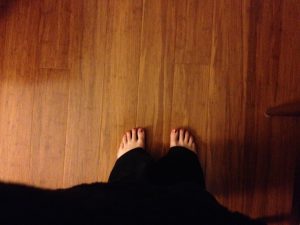
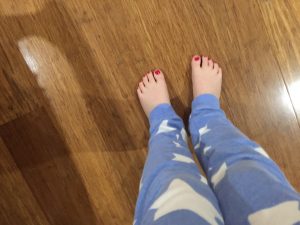
On the topic of photos, Ella uses an old iPhone to listen to podcasts and audiobooks. She’s recently discovered the camera function and has taken (quite enthusiastically) to documenting her life and creating movies! It’s been fun to look through the pictures and videos and get a glimpse of what the world looks like from her perspective. There are lots of selfies and posed pictures of toys and hundreds of walls and windows and floors and ceilings (some quite artistic, some not so much).
I particularly love this one – mainly because exactly 5 years and 12 days earlier I’d taken a very similar shot (in almost the identical spot) as I paced my lounge room in early labour about 10 hours before we met Ella.
The other big news to share since my last H&H update is that I’ve returned to (paid) work following my maternity break. I’m pleased to be facilitating some of the core skills and graduate development training programs at the Australian Public Service Commission, and I’m also doing some freelance facilitation, coaching and training. Helping individuals and groups to learn and change and to see themselves and the world a little differently has been a pretty consistent thread through my work for the past 8 or so years, but facilitation has been a somewhat peripheral part of the various jobs I’ve had. I feel so excited to be diving deeper into this work and to commit to building my own skills, knowledge, experience and practice – it feels like the work I’m meant to be doing. I have some availability for work for the remainder of the year, so if you need some support with running meetings, workshops or training, please get in touch. All the details are over on the Sticky Note Consulting site.
Finally, I’m going to trial sending out Head & Heart updates as a newsletter which may make them easier to follow (for the handful of dear friends that actually read them)! If you’d like to sign up, you can do so here. I’ll keep posting them to the blog too!
 I also finished
